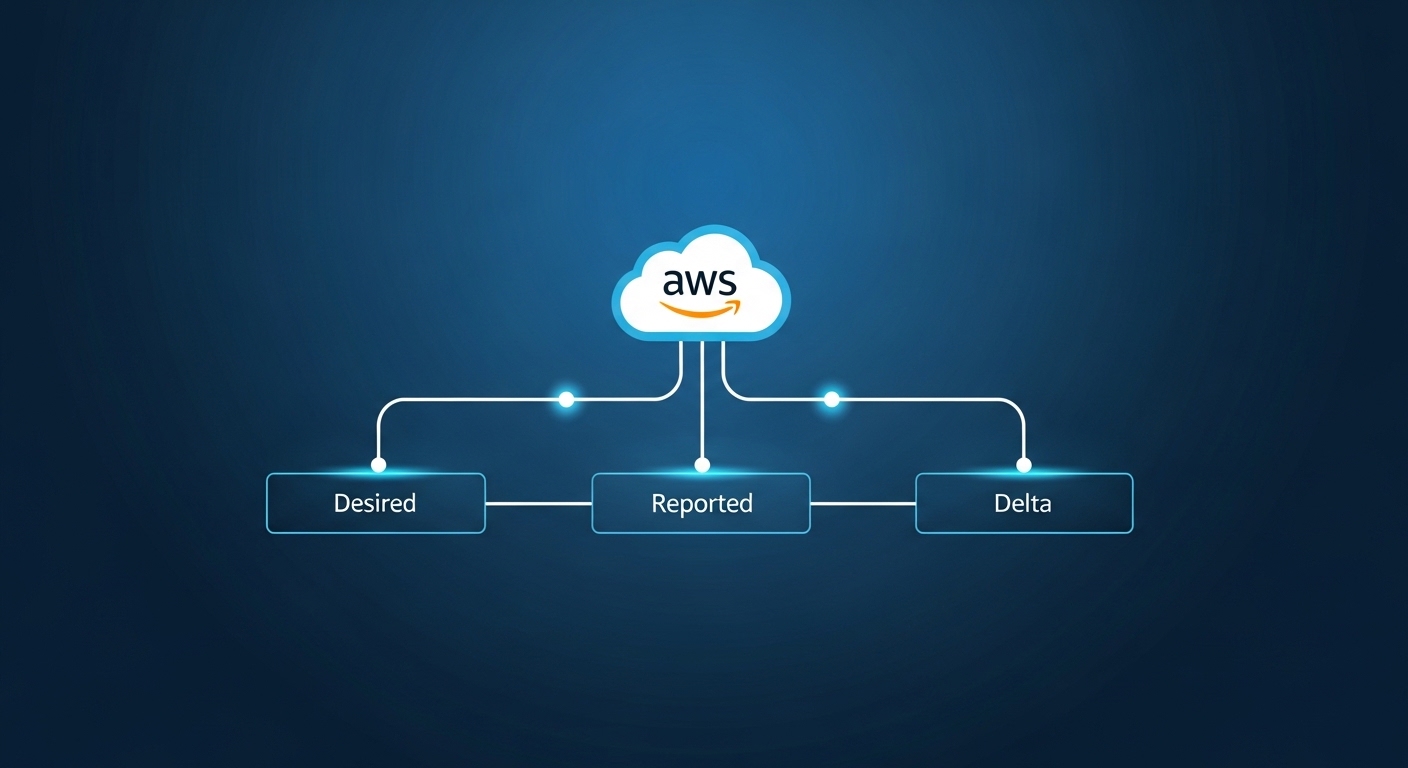
In this project, the Shadow system simulates the AWS IoT Device Shadow, managing the state synchronization between a central control interface (frontend), a local gateway (edge device), and the physical device.
What is a Shadow?
A shadow is a virtual representation of a device’s state in the system. It stores the desired state, the reported state, and the delta (difference).
JSON Structure Example
{
  "state": {
    "desired": {
      "status": 1,
      "permission": 1
    },
    "reported": {
      "status": 0,
      "permission": 1
    }
  },
  "delta": {
    "status": 1
  }
}desired: what the central control wants the device to do.reported: what the device is currently doing.delta: the difference betweendesiredandreported(only present when they differ).
Workflow
- Central control sends the desired state via API.
- Shadow calculates the delta (difference between desired and reported).
- Local gateway fetches the delta and performs the hardware action.
- Device reports its actual state, updating the
reportedfield. - Shadow recalculates the delta. If synchronized, delta becomes empty.
Emergency Local Control
If central control is offline, the local gateway can enter emergency mode and override permission settings for safety reasons.
File Format
Each device has a shadow stored as a JSON file:
shadow_device001.jsonshadow_device002.json- …
These files are managed via the Flask backend.
Environment Setup
OS: Debian 12
Python: 3
sudo apt update -y && apt upgrade -y && \
sudo apt install -y apache2 git python3 python3-pip python3-venv && \
mkdir Shadow && cd Shadow && \
python3 -m venv venv && \
pip install flask && \
source venv/bin/activate && \
mkdir src && \
mkdir shadow
export FLASK_APP=src/main.py && \
export FLASK_ENV=development && \
flask run --host=0.0.0.0 --port=5000Main Program
nano src/main.pyfrom flask import Flask, request, jsonify
import os
import json
app = Flask(__name__)
# === Configuration ===
SHADOW_FILE = os.path.join(os.path.dirname(__file__), '../shadow/shadow.json')
SECRET_KEY = "my-secure-api-key"
# === Pre-request handler (authorization check + request logging) ===
@app.before_request
def before_request():
print(f"Request received: {request.method} {request.path}")
if request.method != "OPTIONS":
token = request.headers.get("Authorization")
if token != SECRET_KEY:
print("Unauthorized request")
return jsonify({"error": "Unauthorized"}), 401
# === Initialize JSON if it does not exist ===
def load_shadow():
if not os.path.exists(SHADOW_FILE):
os.makedirs(os.path.dirname(SHADOW_FILE), exist_ok=True)
data = {
"state": {
"desired": {
"status": 0,
"permission": 1
},
"reported": {
"status": 0,
"permission": 1
}
},
"delta": {}
}
save_shadow(data)
return data
with open(SHADOW_FILE, 'r') as f:
return json.load(f)
def save_shadow(data):
with open(SHADOW_FILE, 'w') as f:
json.dump(data, f, indent=4)
# === Calculate delta field ===
def update_delta(shadow):
desired = shadow["state"].get("desired", {})
reported = shadow["state"].get("reported", {})
delta = {}
for key, val in desired.items():
if reported.get(key) != val:
delta[key] = val
shadow["delta"] = delta
return shadow
# === Update desired / reported ===
@app.route('/shadow/update', methods=['POST'])
def update_shadow():
req = request.get_json()
shadow_type = req.get("type")
update_data = req.get("data", {})
if shadow_type not in ["desired", "reported"]:
return jsonify({"error": "Invalid type"}), 400
shadow = load_shadow()
shadow["state"][shadow_type].update(update_data)
shadow = update_delta(shadow)
save_shadow(shadow)
return jsonify({
"message": f"{shadow_type} updated",
"delta": shadow["delta"]
})
# === Query shadow data ===
@app.route('/shadow/get', methods=['GET'])
def get_shadow_data():
shadow_type = request.args.get("type", "full")
shadow = load_shadow()
if shadow_type == "desired":
return jsonify(shadow["state"]["desired"])
elif shadow_type == "reported":
return jsonify(shadow["state"]["reported"])
elif shadow_type == "delta":
return jsonify(shadow["delta"])
elif shadow_type == "full":
return jsonify(shadow)
else:
return jsonify({"error": "Invalid type"}), 400
# === Start Flask server ===
if __name__ == '__main__':
app.run(host='0.0.0.0', port=5000)Apache2 Configuration
www.conf for HTTP:
sudo nano /etc/apache2/sites-available/www.conf<VirtualHost *:80>
ServerName SERVERNAME
ServerAdmin SERVERADMIN
DocumentRoot /var/www/html
ErrorLog ${APACHE_LOG_DIR}/error.log
CustomLog ${APACHE_LOG_DIR}/access.log combined
#RewriteEngine off
#RewriteCond %{SERVER_NAME} =SERVERNAME
#RewriteRule ^ https://%{SERVER_NAME}%{REQUEST_URI} [END,NE,R=permanent]
</VirtualHost>www-le-ssl.conf for HTTPS:
sudo nano /etc/apache2/sites-available/www-le-ssl.conf<IfModule mod_ssl.c>
<VirtualHost *:443>
ServerName SERVERNAME
ServerAdmin SERVERADMIN
DocumentRoot /var/www/html
ErrorLog ${APACHE_LOG_DIR}/error.log
CustomLog ${APACHE_LOG_DIR}/access.log combined
SSLCertificateFile /etc/letsencrypt/live/SERVERNAME/fullchain.pem
SSLCertificateKeyFile /etc/letsencrypt/live/SERVERNAME/privkey.pem
Include /etc/letsencrypt/options-ssl-apache.conf
# Flask Shadow API reverse proxy
ProxyPreserveHost On
RequestHeader set Authorization "my-secure-api-key"
ProxyPass "/api/" "http://127.0.0.1:5000/"
ProxyPassReverse "/api/" "http://127.0.0.1:5000/"
</VirtualHost>
</IfModule>
SERVERNAME,SERVERADMIN, andmy-secure-api-keyshould be updated to match your actual settings.The
www-le-ssl.conffile should only be written and enabled after the SSL certificate has been successfully created.
The main task for Apache2 here is to reverse-proxy the internal port 5000 (Shadow program) to the
/apipath.
For a basic guide on enabling Apache2 and SSL, refer to: https://www.jw-albert.tw/apache2-install-on-debian-12/
This Project is Synchronized on GitHub
GitHub Link: https://github.com/JW-Albert/IOT_Shadow_Display_UnixFinal/tree/Shadow
本專案中的 Shadow 系統模擬 AWS IoT Device Shadow 的機制,負責管理中央控制介面(前端)、本地閘道(邊緣裝置)與實體裝置之間的狀態同步。
什麼是 Shadow?
Shadow 是系統中裝置狀態的虛擬代理。它儲存三種狀態:期望狀態(desired)、回報狀態(reported) 以及差異值(delta)。
JSON 結構範例
{
  "state": {
    "desired": {
      "status": 1,
      "permission": 1
    },
    "reported": {
      "status": 0,
      "permission": 1
    }
  },
  "delta": {
    "status": 1
  }
}desired:中央控制端期望裝置執行的狀態。reported:裝置目前實際回報的狀態。delta:desired與reported之間的差異(僅在兩者不一致時出現)。
運作流程
- 中央控制端透過 API 送出期望狀態(desired)。
- Shadow 計算差異值(delta = desired − reported)。
- 本地閘道取得 delta,對硬體執行對應動作。
- 裝置回報實際狀態,更新
reported欄位。 - Shadow 重新計算 delta;若兩者已同步,delta 變為空物件。
緊急本地控制
若中央控制端離線,本地閘道可進入緊急模式,基於安全考量強制覆寫權限設定。
檔案格式
每個裝置都有一個以 JSON 檔案儲存的 Shadow:
shadow_device001.jsonshadow_device002.json- …
這些檔案由 Flask 後端統一管理。
環境建置
作業系統:Debian 12
Python:3
sudo apt update -y && apt upgrade -y && \
sudo apt install -y apache2 git python3 python3-pip python3-venv && \
mkdir Shadow && cd Shadow && \
python3 -m venv venv && \
pip install flask && \
source venv/bin/activate && \
mkdir src && \
mkdir shadow
export FLASK_APP=src/main.py && \
export FLASK_ENV=development && \
flask run --host=0.0.0.0 --port=5000主程式
nano src/main.pyfrom flask import Flask, request, jsonify
import os
import json
app = Flask(__name__)
# === 設定 ===
SHADOW_FILE = os.path.join(os.path.dirname(__file__), '../shadow/shadow.json')
SECRET_KEY = "my-secure-api-key"
# === 請求前處理(授權檢查 + 請求日誌) ===
@app.before_request
def before_request():
print(f"收到請求: {request.method} {request.path}")
if request.method != "OPTIONS":
token = request.headers.get("Authorization")
if token != SECRET_KEY:
print("Unauthorized request")
return jsonify({"error": "Unauthorized"}), 401
# === 初始化 JSON(若檔案不存在) ===
def load_shadow():
if not os.path.exists(SHADOW_FILE):
os.makedirs(os.path.dirname(SHADOW_FILE), exist_ok=True)
data = {
"state": {
"desired": {
"status": 0,
"permission": 1
},
"reported": {
"status": 0,
"permission": 1
}
},
"delta": {}
}
save_shadow(data)
return data
with open(SHADOW_FILE, 'r') as f:
return json.load(f)
def save_shadow(data):
with open(SHADOW_FILE, 'w') as f:
json.dump(data, f, indent=4)
# === 計算 delta 欄位 ===
def update_delta(shadow):
desired = shadow["state"].get("desired", {})
reported = shadow["state"].get("reported", {})
delta = {}
for key, val in desired.items():
if reported.get(key) != val:
delta[key] = val
shadow["delta"] = delta
return shadow
# === 更新 desired / reported ===
@app.route('/shadow/update', methods=['POST'])
def update_shadow():
req = request.get_json()
shadow_type = req.get("type")
update_data = req.get("data", {})
if shadow_type not in ["desired", "reported"]:
return jsonify({"error": "Invalid type"}), 400
shadow = load_shadow()
shadow["state"][shadow_type].update(update_data)
shadow = update_delta(shadow)
save_shadow(shadow)
return jsonify({
"message": f"{shadow_type} updated",
"delta": shadow["delta"]
})
# === 查詢 shadow 資料 ===
@app.route('/shadow/get', methods=['GET'])
def get_shadow_data():
shadow_type = request.args.get("type", "full")
shadow = load_shadow()
if shadow_type == "desired":
return jsonify(shadow["state"]["desired"])
elif shadow_type == "reported":
return jsonify(shadow["state"]["reported"])
elif shadow_type == "delta":
return jsonify(shadow["delta"])
elif shadow_type == "full":
return jsonify(shadow)
else:
return jsonify({"error": "Invalid type"}), 400
# === 啟動 Flask 伺服器 ===
if __name__ == '__main__':
app.run(host='0.0.0.0', port=5000)Apache2 設定
HTTP 虛擬主機設定(www.conf):
sudo nano /etc/apache2/sites-available/www.conf<VirtualHost *:80>
ServerName SERVERNAME
ServerAdmin SERVERADMIN
DocumentRoot /var/www/html
ErrorLog ${APACHE_LOG_DIR}/error.log
CustomLog ${APACHE_LOG_DIR}/access.log combined
#RewriteEngine off
#RewriteCond %{SERVER_NAME} =SERVERNAME
#RewriteRule ^ https://%{SERVER_NAME}%{REQUEST_URI} [END,NE,R=permanent]
</VirtualHost>HTTPS 虛擬主機設定(www-le-ssl.conf):
sudo nano /etc/apache2/sites-available/www-le-ssl.conf<IfModule mod_ssl.c>
<VirtualHost *:443>
ServerName SERVERNAME
ServerAdmin SERVERADMIN
DocumentRoot /var/www/html
ErrorLog ${APACHE_LOG_DIR}/error.log
CustomLog ${APACHE_LOG_DIR}/access.log combined
SSLCertificateFile /etc/letsencrypt/live/SERVERNAME/fullchain.pem
SSLCertificateKeyFile /etc/letsencrypt/live/SERVERNAME/privkey.pem
Include /etc/letsencrypt/options-ssl-apache.conf
# Flask Shadow API 反向代理
ProxyPreserveHost On
RequestHeader set Authorization "my-secure-api-key"
ProxyPass "/api/" "http://127.0.0.1:5000/"
ProxyPassReverse "/api/" "http://127.0.0.1:5000/"
</VirtualHost>
</IfModule>
SERVERNAME、SERVERADMIN與my-secure-api-key請替換為實際設定值。
www-le-ssl.conf必須在 SSL 憑證成功申請後才能建立並啟用。
Apache2 在此的主要任務是將內部 5000 埠(Shadow 程式)透過反向代理對應至
/api路徑。
Apache2 與 SSL 啟用的基本教學請參考:https://www.jw-albert.tw/apache2-install-on-debian-12/
本專案已同步至 GitHub
GitHub 連結:https://github.com/JW-Albert/IOT_Shadow_Display_UnixFinal/tree/Shadow